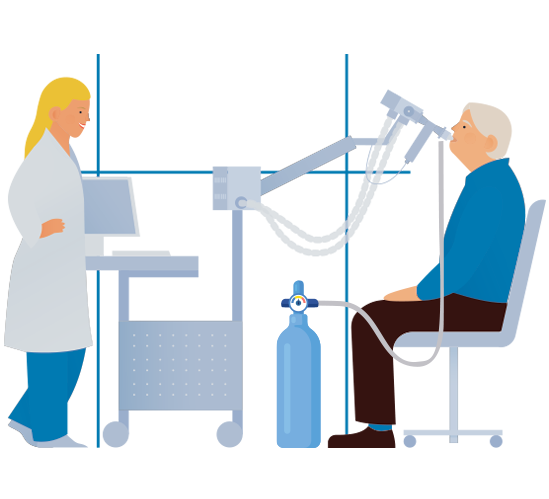
Diffusion Capacity evaluates the Gas Exchange (oxygen and carbon dioxide) : the ability of lungs to transfer gas, from the inhaled Atmospheric Air to the Alveoli and the Circulating Blood, across the Alveolar-Capillary Membrane.
It is based on the inhalation of a specific gas mixture that contains a small amount of carbon monoxide as a tracer. Measurement and Monitoring of Diffusing Capacity over time, is crucial in the diagnosis and monitoring of interstitial lung diseases, such as pulmonary fibrosis and sarcoidosis.
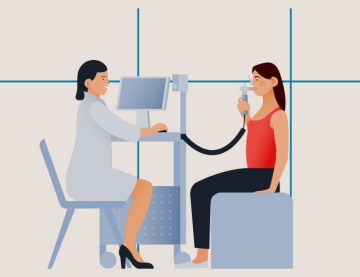
Body Plethysmography is considered the gold standard method in measuring lung volumes and capacities. Using a fixed volume cabin, the system allows us to calculate with great accuracy the volume of air in the lungs and the corresponding lung capacities, at various phases of the respiratory cycle. By body Plethysmography we can:
determine the type of respiratory disorder (restrictive or obstructive syndrome)
diagnose and monitor the progression of restrictive lung diseases such as pulmonary fibrosis
diagnose, monitor, and assess the severity of obstructive airway diseases such as Chronic Obstructive Pulmonary Disease (COPD)
measure Airway Resistance i.e. evaluate the difficulty of air flow during inhalation and exhalation
Preoperative evaluation
Some indicative volumes and capacities:
Total Lung Capacity the total volume of air in the lungs at the end of a maximum inhalation
Residual Volume the volume of air remaining in the lungs after a maximum exhalation
Functional Residual Capacity – the volume of air in the lungs at the end of a normal expiration. It represents the equilibrium position of the respiratory system, where the opposite elastic forces of the chest wall and the lung are balanced( the outward tendency of the chest wall to expand, is balanced by the inward tendency of the lungs to collapse).
Χρησιμοποιούμε cookies για να σας προσφέρουμε την καλύτερη δυνατή εμπειρία στη σελίδα μας. Εάν συνεχίσετε να χρησιμοποιείτε τη σελίδα, θα υποθέσουμε πως είστε ικανοποιημένοι με αυτό.